Two Studies, One Direction: What Off-Market Homes Actually Sell For

For years the pre-market conversation ran on instinct. Agents who used quiet marketing believed it worked. Agents who did not believed it cost the seller money. Nobody had numbers.
Now there are two sets, published five months apart, from two very different places. They do not agree on the size of the effect. They point the same way on the direction of it.
Study one: twenty years, one metro, no dog in the fight
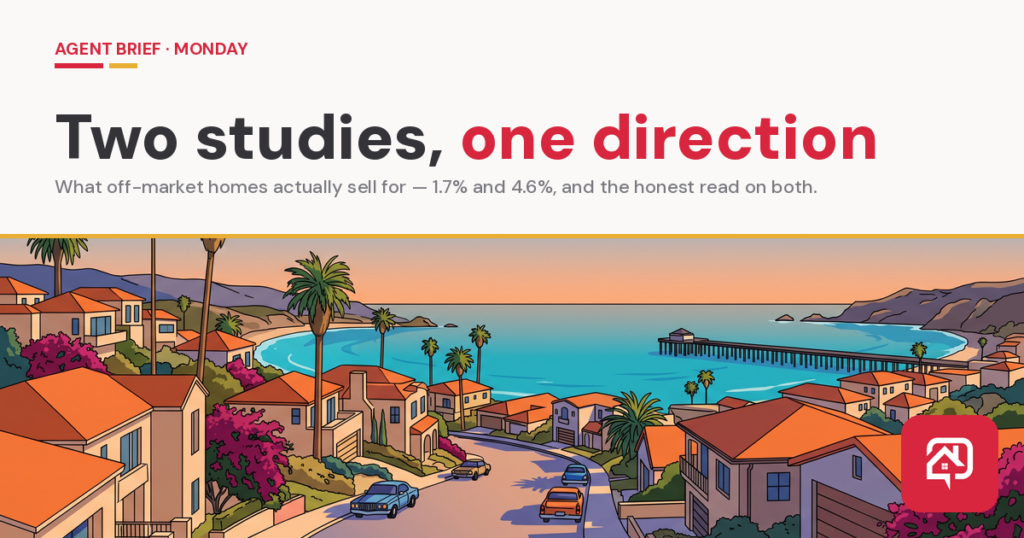
Darren Hayunga, a real estate finance researcher at the University of Georgia, worked through two decades of Dallas-Fort Worth sales data, 2002 through 2022. Published in March 2026 and covered by The Real Deal, the finding was that homes never put on the MLS sold for 1.7 percent more than comparable homes marketed through the MLS.
Three things about that number are worth holding onto.
- It is small. On a $1,500,000 sale it is about $25,000. Real money, not a revolution.
- It came from an academic with no brokerage, portal, or platform behind him. That is rare in this debate and it is the reason this study carries the weight it does.
- The premium disappeared in 2020, the year the 24-hour marketing window arrived. It came back as the window loosened.
Hayunga also measured how common the practice was. At its 2022 peak, pocket listings were 3 percent of Dallas-Fort Worth sales. Three percent. The category everyone argues about is, by volume, a rounding error — which tells you the argument was never really about volume.
Study two: one brokerage, one year, 70,809 closings
In July 2026, Compass published an analysis of 70,809 of its own transactions from April 2025 through March 2026. As reported by Inman, homes that began as Private Exclusives or Coming Soons sold for 4.6 percent more than comparable homes that went straight to the MLS and the portals, with a 95 percent confidence interval of 4.2 to 4.9 percent. Those homes also went under contract 34 percent faster once active and were 29 percent less likely to take a price cut.
Read that with the label attached: this is Compass measuring Compass, using Compass’s own definition of a comparable home, in support of a position Compass was arguing in court. Zillow’s expert filed a declaration disputing the analysis. A brokerage studying its own product is evidence, not proof, and anyone quoting 4.6 percent to a seller should say whose number it is.
One figure from that same body of testimony travels better than the price premium: Compass’s CEO testified that 94 percent of listings that start in a private phase end up publicly on the MLS anyway.
Where the two studies meet
1.7 percent from a neutral academic. 4.6 percent from an interested brokerage. Split the difference however you like — the honest read is that the effect is positive and modest, somewhere in low single digits, and that the market has never produced a credible study showing quiet marketing costs the seller money.
That is a smaller claim than either side of this argument usually makes. It is also the one you can defend at a listing appointment without overselling.
What it means for the way you work
The 94 percent number is the practical one. Pre-market is a phase, not a destination. Almost everything that starts quiet goes public. What the quiet phase buys is a controlled first look: price testing without a days-on-market counter running, feedback from real agents with real buyers, and the chance to sell before the listing ever needs a price reduction.
Which means the value of that phase depends entirely on one thing — how many good agents actually see it. A private phase that reaches four people in your office is not a marketing strategy. A private phase that reaches 2,600 licensed agents across 62 brokerages is.
That is the whole reason this network exists. Post the property, keep the address and price behind the member wall, and let the agents who hold matching buyers come to you. It takes about ninety seconds.